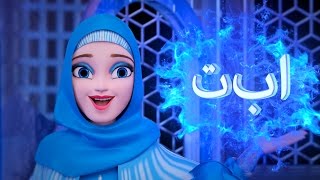
Arabic for kids
Arabic Alphabet for Kids: A Parent's Guide to the 28 Letters
By the Baby Learning World team · Updated 17 September 2026
Our Arabic Alphabet Song with Princess Fatimah has been watched more than ten million times by families around the world. This guide goes with it: all 28 letters, how they sound, and easy ways to practise at home, even if your own Arabic is rusty.
Arabic alphabet basics
- 28 letters. The standard Arabic alphabet has 28 letters, and all of them are consonants. Three of them (alif, waaw and yaa) also represent long vowels.
- Right to left. Arabic is written and read from right to left.
- Joined-up writing. Most letters join to the letters around them and change shape slightly depending on whether they're at the start, middle or end of a word.
- Short vowels are marks. Short vowels are shown with small marks above or below letters (fatha, kasra and damma). Children's books usually include them.
The 28 letters with names and sounds
| # | Letter | Name | Sound (approximate) |
|---|---|---|---|
| 1 | ا | alif | a (as in 'father') |
| 2 | ب | baa | b |
| 3 | ت | taa | t |
| 4 | ث | thaa | th (as in 'think') |
| 5 | ج | jiim | j |
| 6 | ح | Haa | a breathy h from the throat |
| 7 | خ | khaa | kh (like Scottish 'loch') |
| 8 | د | daal | d |
| 9 | ذ | dhaal | th (as in 'this') |
| 10 | ر | raa | rolled r |
| 11 | ز | zaay | z |
| 12 | س | siin | s |
| 13 | ش | shiin | sh |
| 14 | ص | Saad | a heavy s |
| 15 | ض | Daad | a heavy d |
| 16 | ط | Taa | a heavy t |
| 17 | ظ | DHaa | a heavy th (as in 'this') |
| 18 | ع | 'ayn | a sound from deep in the throat |
| 19 | غ | ghayn | gh (like a French r) |
| 20 | ف | faa | f |
| 21 | ق | qaaf | q, a k from far back in the throat |
| 22 | ك | kaaf | k |
| 23 | ل | laam | l |
| 24 | م | miim | m |
| 25 | ن | nuun | n |
| 26 | ه | haa | h |
| 27 | و | waaw | w (or a long 'oo') |
| 28 | ي | yaa | y (or a long 'ee') |
Sounds are approximate English guides. Several Arabic sounds don't exist in English, so listening to a native speaker or our song is the best way to learn them.
Learn letters in shape families
Many Arabic letters share the same basic shape and are told apart only by their dots. Teaching them in groups makes this easier to see:
- ب ت ث (baa, taa, thaa): the same "boat" shape with one dot below, two above, or three above.
- ج ح خ (jiim, Haa, khaa): the same curve with a dot inside, no dot, or a dot above.
- د ذ and ر ز: pairs where only one dot is different.
- س ش and ص ض: pairs with and without dots.
Easy ways to practise at home
- Sing daily. The alphabet song teaches the order of the letters and the names at the same time.
- Letter of the week. Stick one letter on the fridge and find words that start with it: ب for بيت (bayt, house), ق for قطة (qiṭṭa, cat).
- Dot games. Draw a letter shape without its dots and let your child add them to make different letters.
- Sand and playdough. Trace letters in a sand tray or roll them from playdough, starting from the right.
- Name first. Write your child's name in Arabic and English and compare the letters.
Tips for bilingual families
Children can learn two or more languages from birth, and it doesn't cause language delay. Many families use a simple rule, such as one parent speaking Arabic, or Arabic at home and English outside. Consistency matters more than the method.
If you live outside an Arabic-speaking country, songs, stories, video calls with relatives and community classes all help keep the language alive. Our guide to Arabic learning toys and books has more ideas.
Heads up: letter names are sometimes spelled differently in English (for example jeem or jiim, seen or siin). They're the same letters.
Questions parents ask
How many letters are in the Arabic alphabet?
There are 28 letters in the standard Arabic alphabet. Some teachers also count the hamza (ء) separately.
What is the first letter of the Arabic alphabet?
The first letter is alif (ا). The last is yaa (ي).
Is Arabic written left to right?
No. Arabic is written and read from right to left, although numbers are read left to right.
What age can children start learning Arabic letters?
Children can enjoy Arabic songs from babyhood. Recognising letters usually comes from about three or four, similar to learning English letters.
Can my child learn Arabic and English letters at the same time?
Yes. Young children are good at keeping languages apart, especially when each has its own songs, books and routines.